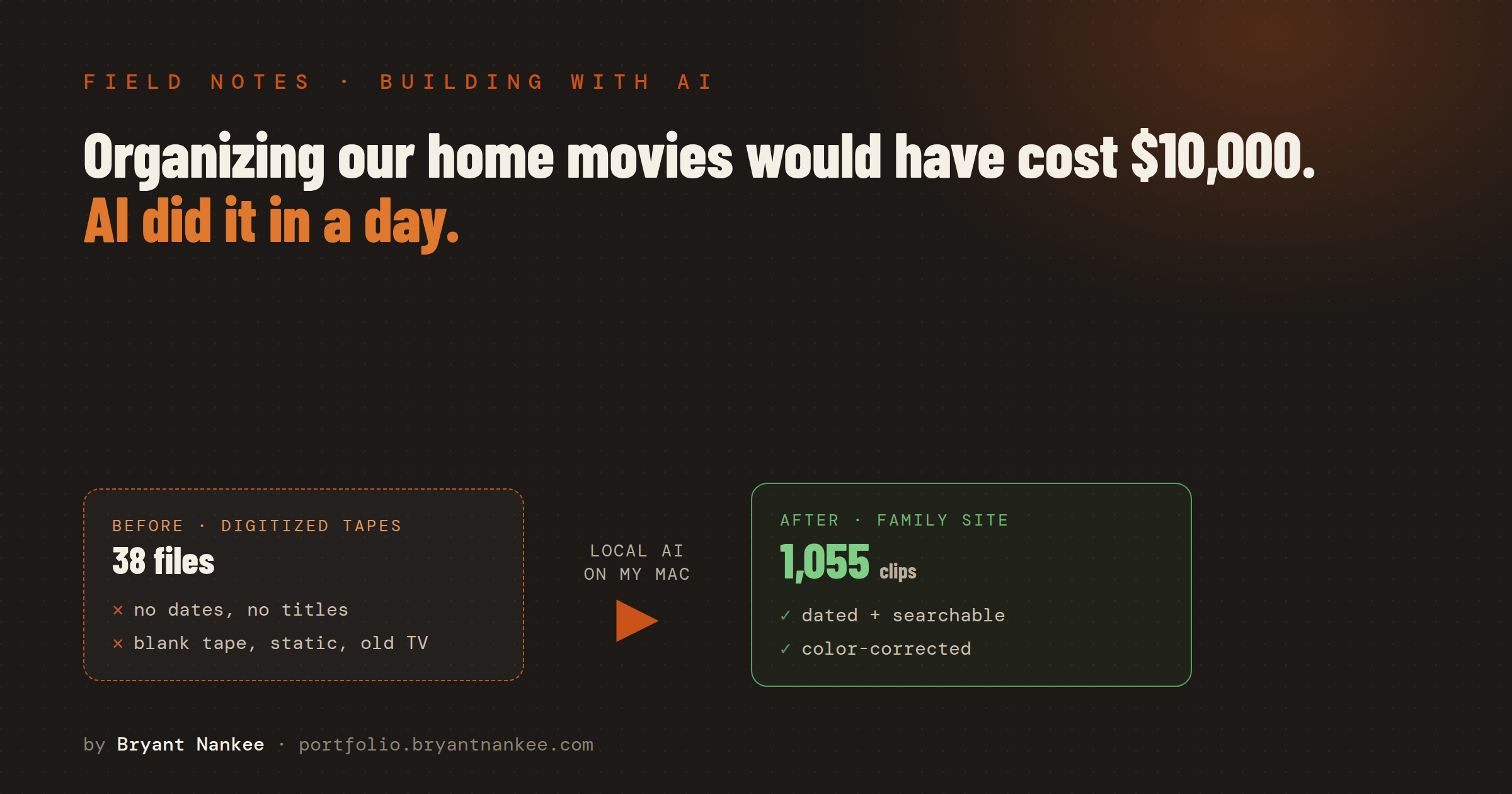
A few years ago my family sent a box of old VHS tapes to Legacybox, one of the services that digitizes home movies. They did what they promised. The tapes came back as 38 video files, about 76 hours of our family in the 1990s: birthdays, Christmas mornings, school plays, vacations.
And then, like most digitized home movies, they mostly sat there. Each file is a whole tape, two hours or more of mixed footage in no particular order. Somewhere in there is a birthday from 1994, but finding it means scrubbing through hours of video. Some of the tape is blank or snow. Some of it is a cartoon someone taped off TV in 1992.
I wanted to see how far AI could go on a job like this. The answer surprised me: in about one day, working with Claude, the whole collection became 1,055 short clips, dated, titled, color-corrected and searchable, on a private site my family can open from anywhere.
The whyA test of how far this has come
AI is moving fast enough that I keep resetting what I think is possible. This felt like a good stress test. Doing it properly means watching every minute of tape, working out when each scene was filmed and who's in it, cutting out the junk, fixing the faded color, and organizing it all into something a family can browse. A few years ago that meant paying someone to sit with the footage. By my estimate, that's hundreds of hours of work and well over $10,000.
I also had two rules. Everything that "watched" the footage had to run on my own computer, since these are private family videos. And I wasn't going to pay for AI upscaling or any other per-minute service.
A job that once meant hundreds of hours of someone watching tape took us about a day.
The pipelineTeaching a computer to watch our home movies
Claude did the engineering: it wrote each step, ran it on a few tapes, and fixed what came out wrong. All of the analysis runs on my Mac with free, open-source tools and AI models. No footage was sent to an AI service.
- Skim every tape. One fast pass through each file grabs a still frame every few seconds and notes every hard cut, blank stretch, blue screen and burst of static.
- Read the date stamp. Camcorders of that era burned the date into the corner of the picture. The Mac's built-in text recognition reads it off the frames, which gives most scenes an exact date.
- Split it into scenes. Each tape is cut into separate recordings wherever the tape goes blank or the date changes. Anything longer than five minutes is split again into 2 to 5 minute parts at natural camera cuts, so nobody has to sit through a 40-minute recording to find one moment.
- Listen. A speech-to-text model transcribes what's being said, which makes the clips searchable by what people say, not just what they show.
- Look and describe. A vision model running locally looks at a sheet of frames from each scene, along with its date, the transcript, and how old each family member was on that date. It writes a title and a short description, and suggests who's in the scene only when it's clearly visible. It also flags scenes taped off TV, which we left out of the archive.
- Clean it up. Each clip gets the noisy strip at the bottom of the frame cropped, a light denoise, automatic levels and white balance, a bit more color and sharpening, and evened-out audio.
- Shrink it. Modern compression looks the same as the source at less than half the size. With blank tape and TV trimmed out, 56 GB became about 20 GB.
Five tapes that wouldn't open
Not everything went smoothly. Five of the files had never finished downloading back in 2023. The video players refused them, and most of each file was empty. Legacybox no longer had copies. Claude found an open-source repair tool that rebuilds a broken video file using a healthy file from the same batch as a reference. It recovered everything that was actually there, including more than an hour from one tape. The rest is gone, but we got back footage I'd assumed was lost.
The siteA photo album you can search
A folder of 1,055 files is better than 38 giant ones, but it's still a folder. So the last step was a private website, designed to feel like a family photo album instead of a video app: big year headings, a print-style card for each recording, and parts that play one after another.
- Search and filters by person, year or occasion. "Christmas" finds every Christmas.
- Family fixes. Anyone in the family can tag who's in a clip or correct a title or date, because my parents remember things no AI could guess.
- Share links. Every clip has its own link, so it is easy to send one moment to a relative.
- Family only. The site sits behind a login that only works for our family's email addresses, and every clip is stored privately.
Instead of scrubbing through 76 hours of tape, you type what you're looking for.
The payoffIt finally gets watched
My parents and my sister love it. What they keep coming back to is that they can open it anywhere and search for anything. Before, finding one moment meant guessing which tape it was on and scrubbing through hours of footage.
The best test is coming up. We've got every Christmas tape tagged, and the plan is to work through them together over the holidays this year.
The AI makes mistakes. It sometimes guesses a date or a title wrong, especially on scenes without a date stamp, which is why the family can fix them. It also can't recognize faces, so it suggests who's in a scene only from age and what's clearly visible, and the family fills in the rest. This approach also needs a capable computer: the vision model and transcription ran on a Mac with a lot of memory, and I'd already set it up for running AI locally. And I skipped AI upscaling. The clips look like clean 1990s VHS, not like modern video.
The bar for "too much work" keeps dropping
The cost of this project used to be almost entirely human time: watching, logging, cutting, labeling. That's exactly the kind of work AI has gotten good at, and it can now run on a computer at home, which matters when the footage is your family's.
If you have a box of tapes, or files from a digitizing service you've never really watched, the hard part is no longer the work. It's deciding to spend a day on it.