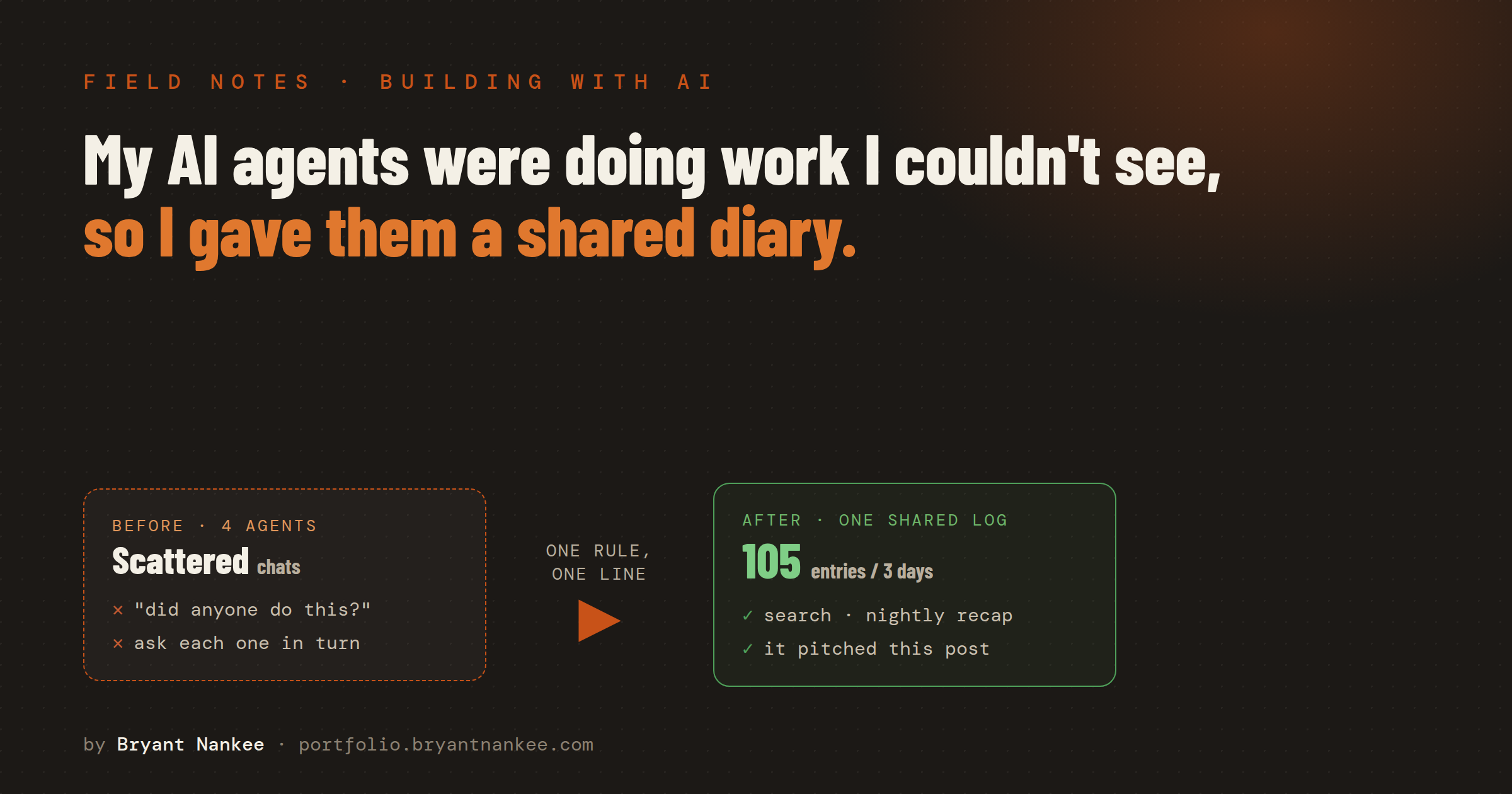
A year ago, "my AI" meant one chat window. Now it means a small team. There's Hermes, which runs on the old laptop I turned into a server. There's Muse and Hark, which handle research, errands, and scheduled check-ins. And there's Claude Code, which I use for building. They each have their own home, their own memory, and their own chat history.
That's great until you ask a simple question: what actually got done this week? Or worse, didn't one of you already handle this? The answer existed, but it was scattered across four chat histories on three machines. Finding it meant asking each agent in turn, or scrolling back through conversations until I gave up.
I had built a team that was productive and also invisible.
The whyA team needs a shared record
Any team of people would hit the same wall. If five coworkers each kept private notes and never wrote anything down in a shared place, the work would still happen, but nobody could tell you what happened, who did it, or why. That's why teams have standups, tickets, and changelogs. It's not bureaucracy. It's how a group remembers.
My agents had no equivalent. Each one remembered its own work, sort of, and nothing else. So I gave them the simplest version of a shared memory I could think of: a diary. One entry per real piece of work, written by whoever did it.
I had built a team that was productive and also invisible.
The buildOne rule, one line, every agent
The log itself is deliberately boring. It's a tiny database on my home server, reachable only from my private network, with a one-line command any agent can run. Each agent has its own key, so every entry is signed by whoever wrote it. Fittingly, one of the agents built it: Muse wrote the first version. Then each of the others was connected and given the same instruction.
When you finish a task, make a decision, change a setting, or take an action out in the world, log it. One entry per finished piece of work. Don't log every step, don't log your thinking, and don't log routine checks that found nothing.
An entry is just a title, a sentence or two on the outcome, a category, and a few tags. That's on purpose. If logging were a chore, the agents would do it badly and I'd never read it. Short entries get written, and they get read.
The story only shows up when you read it together
The best example happened the week I built it. Muse spent a weekend building a system that opens my garage door when my car pulls in. It ran, but it never fired. Later, Claude Code picked up the problem, found the bug, and fixed it while I drove around the block to test it. (That's its own post.)
In any single agent's chat history, that's a fragment. In the log, it's the whole story in order: research, first build, the failure, the handoff, the fix, the test drive, the tuning. Two different agents, one timeline. For the first time I could see my agents working together, not just side by side.
It also showed me things I didn't love. A lot of what agents want to report is noise, like "checked the inbox, nothing new" or "watchdog restarted a service." Even with the rule, some of that gets through, and I'm still deciding what counts as worth logging. And the log is only as honest as the agents writing to it. If an agent doesn't log something, the diary has a hole and nobody notices.
The twistThen it started doing jobs I hadn't planned
Once everything lands in one place, other things can read it. That's when the diary stopped being just a record.
First, a searchable table. Every entry is copied into a Notion database, so "when did we change the Wi-Fi?" is a search, not an interrogation.
Second, a nightly recap: one email, grouped by project, of everything my agents did that day. It even produced its own small story in week one. The recap failed one night because a network login had expired. The failure got logged, the login was fixed, and an agent rebuilt and sent the missed recap by hand. The system recorded its own hiccup.
Third, and my favorite: blog ideas. Every Sunday evening, an AI reads the week's entries, ignores the routine stuff, skips anything private like finances or family, and pitches me two or three ideas that would make good stories here. It checks what I've already published so it doesn't repeat itself, and it lists the questions only I can answer.
The first idea it ever pitched was this post.
The payoffFrom "ask around" to "look it up"
The practical change is simple. Questions that used to mean pinging four agents and hoping one remembered now take a search. When an agent picks up a task, it can check whether someone already tried. And at the end of a week, I know what my team did without asking anyone.
It cost nothing but a bit of building time, and it runs on hardware I already had. There are paid observability platforms for AI agents, mostly built for engineering teams tracing every step a model takes. I didn't need traces. I needed a diary.
The log depends on every agent following the rule, and agents are inconsistent note-takers, just like people. Some entries are too vague, some are noise, and some work never gets logged at all. It also means one more small service on my server to keep running. And because entries can mention anything my agents touch, I had to be deliberate about what's private and what's shareable. That's why the blog-ideas step has hard rules about what it may never pitch.
Once you have a team, give it a memory
Running several AI agents is starting to look a lot like managing a small team, and it runs into the same problems. The fix is also the same one: a shared, written record. It doesn't need to be clever. One rule, one line per real task, and one place to read it.
Build that, and the record starts paying you back in ways you didn't plan. Mine became a search engine, a nightly briefing, and, as it turns out, an editor.